

Project Description
Squirrel for Mayor is a research-creation project that uses art, humour, and civic engagement to explore the city as a multispecies landscape. Working across performance, creative storytelling, and policy research, the project examines the relationships among urban development, ecological stewardship, and political representation. Housing, transportation, urban forests, and public spaces appear as interconnected systems through which the conditions of shared life are negotiated.
Informed by my practice of Squirrealism, the project introduces the squirrel as a figure through which familiar civic questions can be reconsidered. Associated with curiosity, adaptability, and planning for the future, the squirrel shifts attention from the council chamber to the canopy, where property boundaries intersect with habitats, movement, and seasonal rhythms. This perspective asks whose needs are recognized in urban planning and how other species might become participants in imagining the city.
Situated within Victoria’s urbanized Garry oak ecosystem, Squirrel for Mayor attends to the living relationships beneath the language of land use and development. Trees, soils, wildlife, and water sustain neighbourhoods while exceeding the boundaries through which land is owned and governed. The project considers how these ecological relationships are valued, measured, or overlooked when a living landscape becomes a collection of properties, infrastructure, and development sites.
The use of a nonhuman civic persona connects the work to a history of artistic interventions in public debate, including Vincent Trasov’s Mr. Peanut and James Skwarok’s Mr. Floatie. Humour creates an opening for participation, making questions of authority, belonging, and responsibility accessible through an unexpected representative. The squirrel’s imagined candidacy brings the limits of human political representation into view.
Beginning as a performative art project, Squirrel for Mayor has developed into a platform for research, policy analysis, and public engagement. Its activities include examining urban forest governance and housing legislation, sharing developments in Garry oak mapping, and contributing to community conservation initiatives. Across these forms, the project asks how civic decisions might account for lives beyond the human, and what it would mean to build cities in which multispecies communities can thrive together.
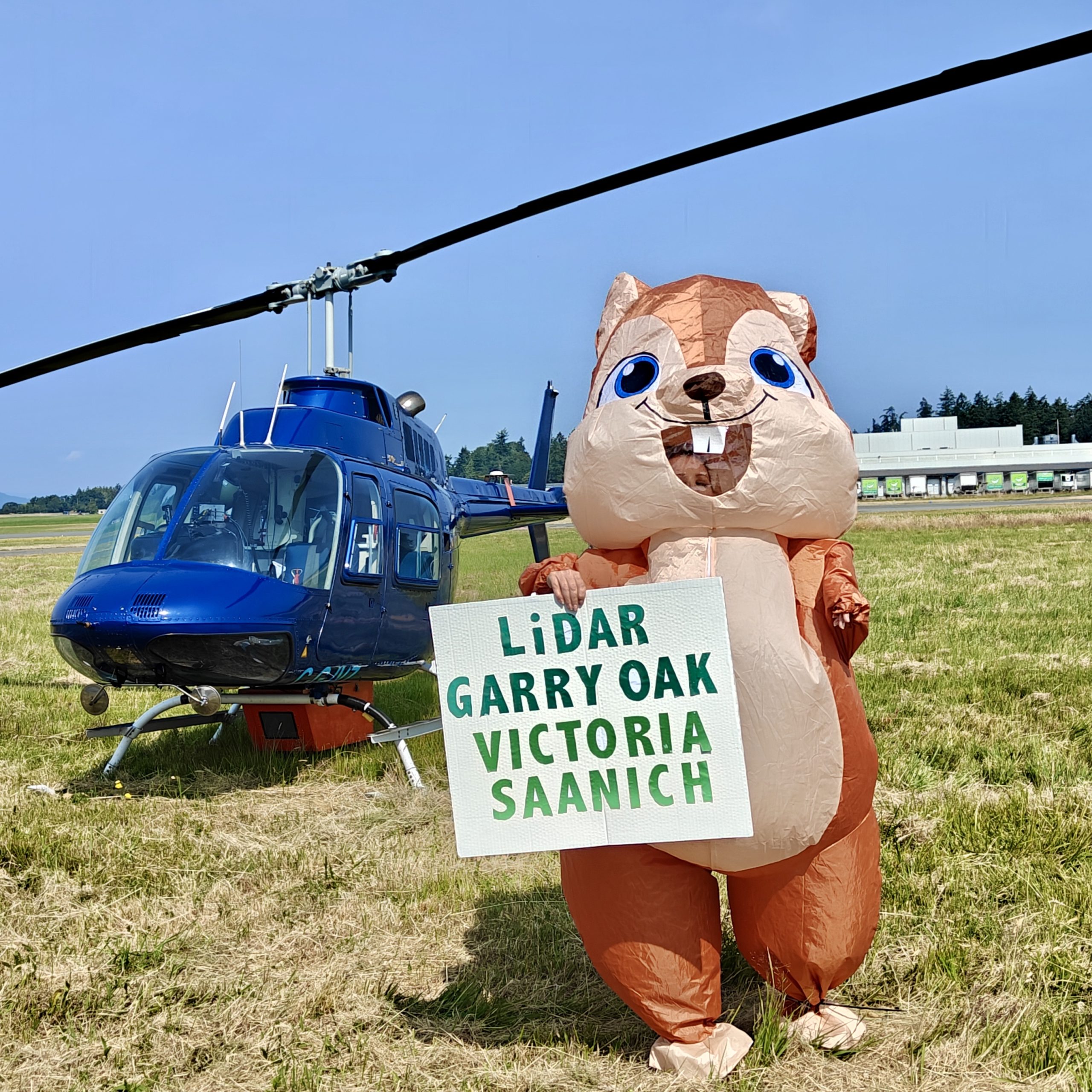
Photo by Ryan Senechal. On location at the Victoria International Airport. Bell 206B3 Jet Ranger, equipped with a Phase One IXM-100 camera to capture data on the urban forest: City of Victoria and urban containment boundary of Saanich.