
Project Description
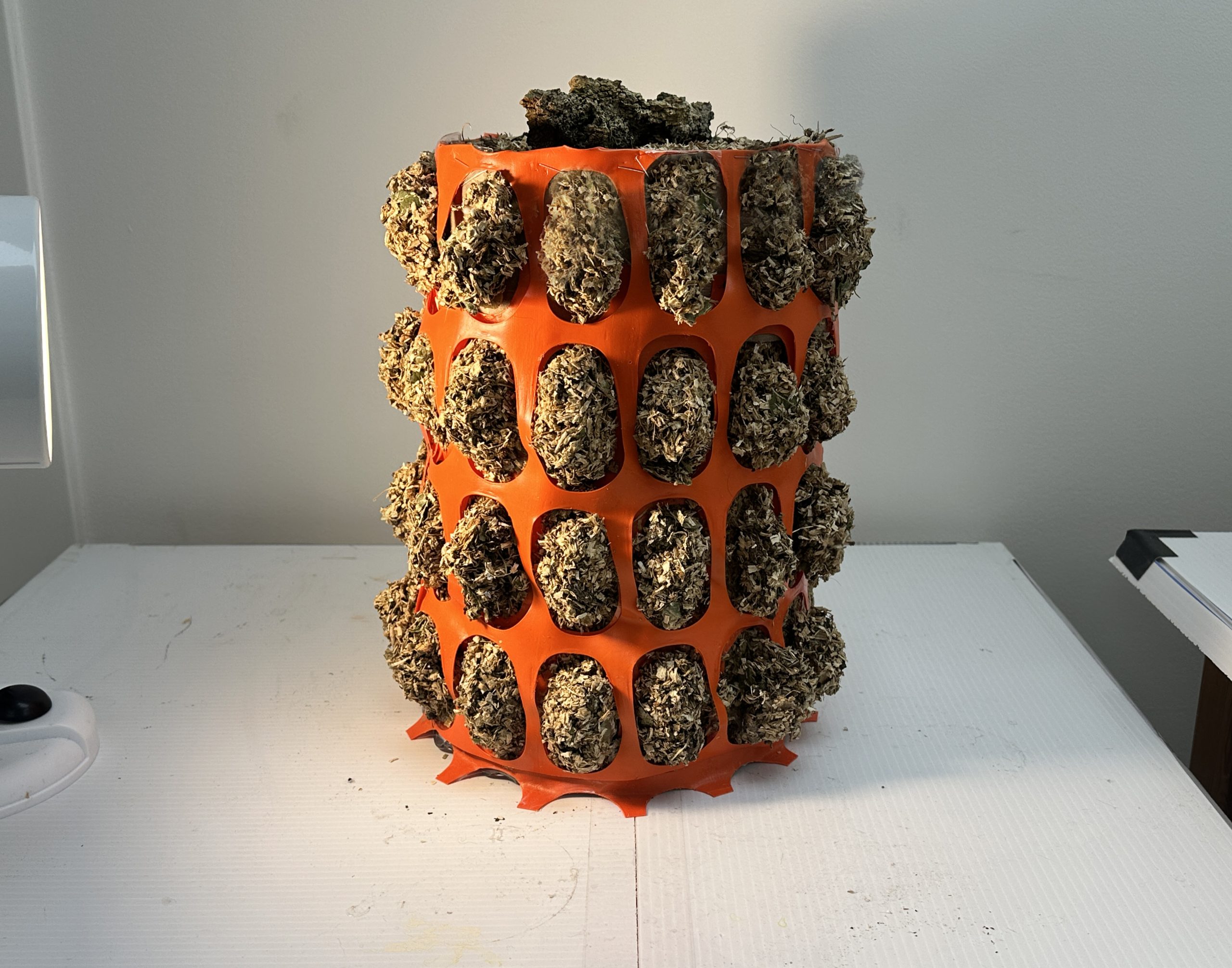
IMAGE: Memory of a Thousand Seasons, 11″ X 11″ x 13″, Garry oak sawdust, found plastic tree fencing, 2025.
Memory of a Thousand Seasons (2025–ongoing) is an interactive artwork composed of Garry oak bark and sawdust alongside fragments of orange plastic construction fencing collected from around Garry oak trees on southern Vancouver Island. Across the region, expanding roads and construction are placing increasing pressure on the survival of Garry oak trees and their already-imperilled ecosystems. The work considers what these materials might communicate about disruption, containment and ecological survival.
The project began when I encountered a centuries-old Garry oak that had lost a massive limb following nearby roadwork. The fallen branch had been removed, leaving behind mounds of sawdust—the powdered memory of a thousand seasons. I gathered the sawdust by hand and brought it into my studio, together with fragments of orange fencing collected while walking and foraging in my neighbourhood.
Guided by my hybrid research method, Squirrealism, I approached the material through psychometry and interspecies listening. After washing my hands, centring myself and asking the tree for permission to communicate through touch, I immersed my bare hands in the sawdust and asked: What is your greatest concern for survival? The response arrived through images and sensations: suffocation, division, and containment mistaken for protection.
Recurring throughout the work is the relationship between the raised cellular structure of Garry oak bark and the grid of the plastic fencing. The deep fissures of the bark evoke Voronoi patterns—naturally occurring structures through which space is organized around points of connection. The resemblance also suggested cellular networks and batteries. I later learned that calcium, found within Garry oak bark, plays an important role in cellular communication, while calcium ions are also being explored in battery technologies. Voronoi clustering is similarly used to improve communication within wireless networks. These associations became unexpected echoes of a broader forest logic.
Rather than understanding the plastic only as a contaminant, Memory of a Thousand Seasons considers how communication might persist across imposed boundaries. The materials appear to speak about interrupted relationships: between trees and soil, roots and mycorrhizal networks, ecological processes and human systems of development. The fencing promises protection while simultaneously dividing, restricting and enclosing the living world.
With the tree’s perceived permission, viewers are invited to participate by hovering their hands above the bark, fencing and sawdust. Through this gesture, the artwork becomes a space for listening to the Garry oak “battery” and attending to whatever images, sensations or questions arise.
What will you ask? What do you sense this species needs in order to survive?
Through Squirrealism, psychometry and interspecies listening, I understand art as a form of ecological translation—a practice in which intuition becomes method and materials become mediators. Listening through touch re-centres relational ways of knowing and proposes that communication—across species, systems and scales—is essential to collective survival.
Related presentation
I discussed Memory of a Thousand Seasons in Squirrealism and Urban Ecologies: Listening through Psychometry, presented at the ARTISTic Symposium, University of Sunderland, on 18 February 2026.