
Project Description
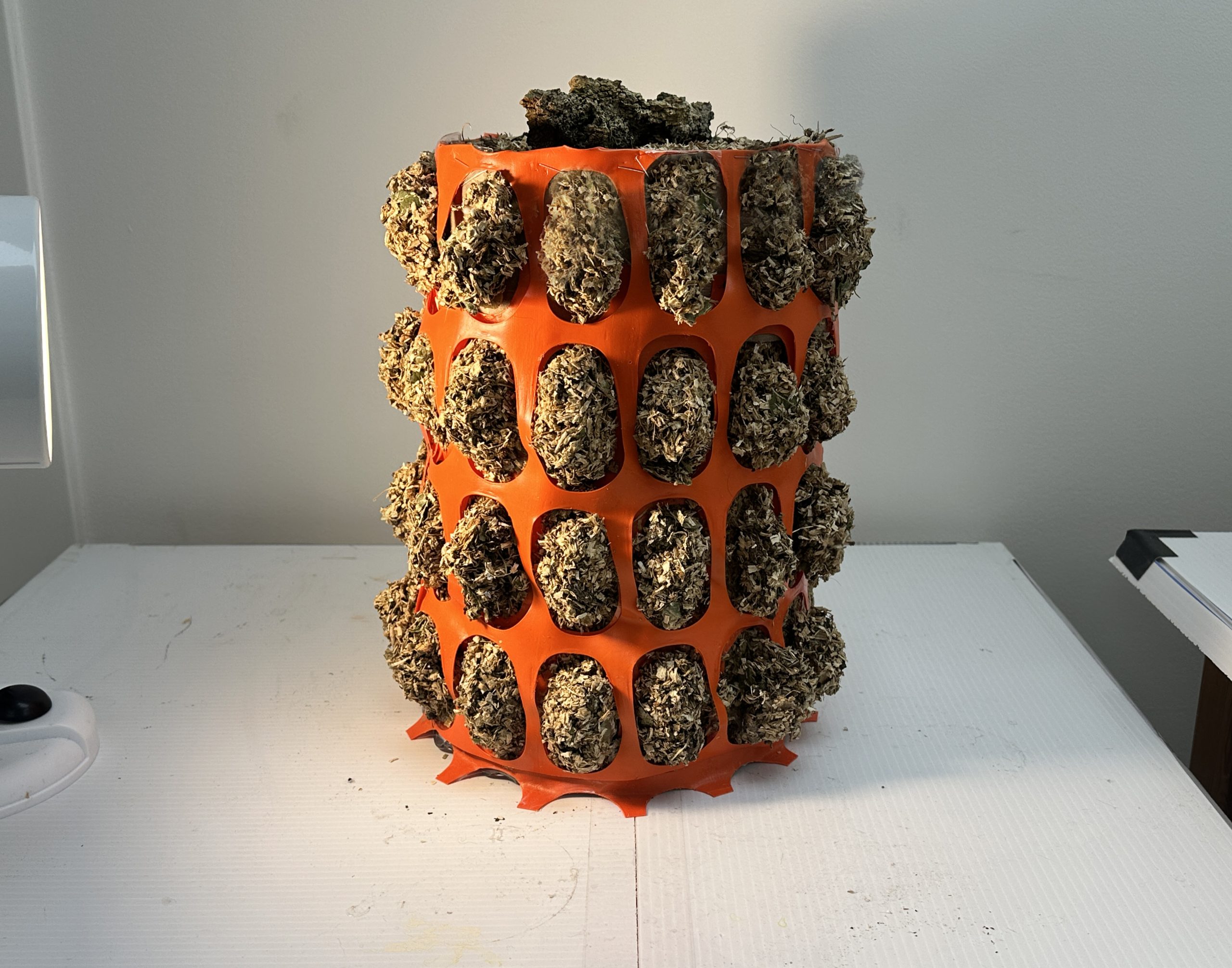
IMAGE: Memory of a Thousand Seasons, 11″ X 11″ x 13″, Garry oak sawdust, found plastic tree fencing, 2025.
Across our region on southern Vancouver Island, new roads and construction sites are proliferating, placing ever-increasing pressure on the survival of the rare Garry oak tree species and ecosystem.
While walking and foraging for materials, I began collecting fragments of debris—orange plastic fencing—from around Garry oak trees in my neighbourhood.
I soon came upon a centuries-old tree that had lost a massive limb after nearby roadwork. The remnants of the large branch failure had been removed, leaving only mounds of sawdust—the powdered memory of a thousand seasons. I scooped the sawdust up with my hands.
Back in my studio, I followed my hybrid research method called Squirrealism—by first washing my hands. I then took three deep breaths to centre myself, and asked the Garry oak for permission to communicate using psychometry—the extra sensory perception using touch—to work with their matter. I immersed my bare hands in their sawdust and asked the tree: What is your greatest concern for survival?
The answer came as images—suffocation, division, containment mistaken for protection. I moved my hands through the sawdust I also held and moved around other materials like orange fencing collected from the site and wondered whether the oak trees could “feel” the presence of plastic through altered microclimates, soil aeration, and mycorrhizal networks.
Rather than contamination from plastic, the message seemed to be about communication and grid systems—about maintaining connection through imposed boundaries.
Garry oak bark has a raised cell structure defined by fissures, echoing natural patterns for spacing and growth. The cells reminded me of microbiology, and the aesthetic affect resembled a cell battery. Later, I learned that Garry oak bark contains calcium—essential for communication in both tree and human cellular systems, as do batteries that employ calcium ions.
I began to see how the bark resembled Voronoi patterns (Voh-roh-NOY) — natural communication grids. I realized the message wasn’t about plastic contamination, but about connection through imposed boundaries.
Interestingly, I have since learned that in wireless networks, Voronoi clustering improves communication—an unexpected echo of forest logic.
I asked the tree if other humans would be allowed to “feel” them in this interactive artwork. They were open; therefore, this will be an interactive piece.
In the artwork Memory of a Thousand Seasons, viewers are invited to hover their hands above the 500-year-old oak bark, fencing, and sawdust to listen for themselves to the Garry oak “battery” and see what images arise.
What questions will you ask? What do you sense this species needs to survive?
Through Squirrealism, psychometry, and interspecies listening, I’ve come to see art as a form of ecological translation—where intuition becomes method and materials become mediators.
Listening through touch re-centres relational ways of knowing and reminds us that communication—across species, systems, and scales—is the essence of survival.