
Project Description

A PARTICIPATORY ARCHIVE
Squirrel Database
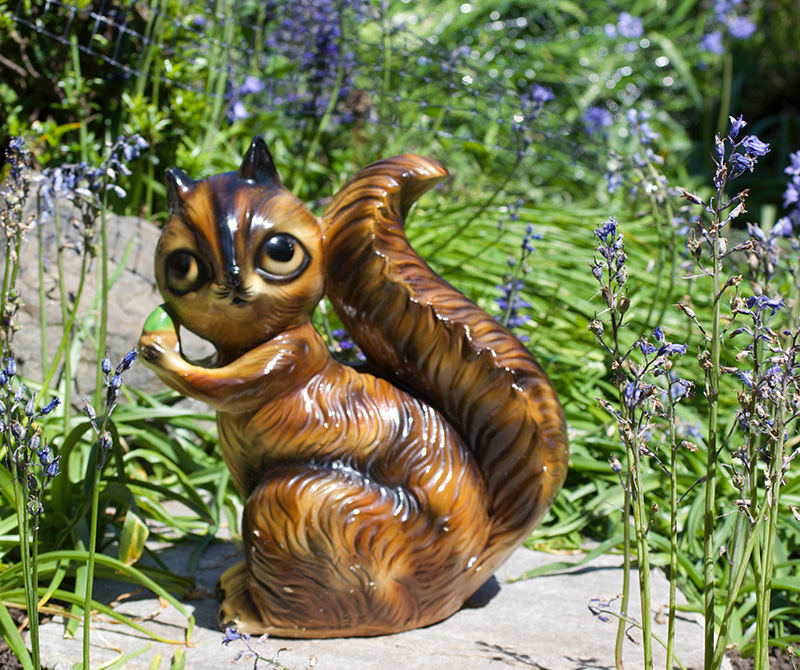
Squirrel Database is a participatory archive of squirrel-themed objects, photographs, videos, and digital imagery, gathered largely through gifts received since 2007.
Emerging alongside my practice of Squirrealism, the collection explores how squirrels circulate through visual culture and how an artistic relationship with a species can become a shared activity.
A collection shaped by giving
An earlier object anchors the collection: a 1970s chalkware squirrel-shaped coin bank bequeathed to me by my grandmother in 1998. This personal inheritance precedes the hundreds of objects and images subsequently sent by friends, acquaintances, and members of the public. Together, these contributions connect family memory with the unexpected associations through which people encounter and recognize my work.
Made publicly accessible in spring 2022, the searchable database brings these dispersed gifts into a shared repository. Cataloguing preserves both the objects and, where known, the circumstances of their arrival. The collection becomes a record of squirrel representation and of relationships formed through giving, noticing, and remembering.
Squirrel Database asks how a community builds a collection together while apart, and what everyday objects reveal about our attachments to other species.
Building the archive
The database began with a practical question: how could I catalogue a growing collection of physical objects, place them in storage, and continue to access their images and histories? Information initially recorded on yellow sticky notes needed a more durable and searchable home. I considered Excel and Apple Numbers, but entering records directly into a collections-management system offered a way to avoid duplicating work during a later migration.
With research and technical assistance from Graham Nott, I selected CollectiveAccess, an open-source platform for managing and publishing museum and archival collections. My considerations included software support, configurable categories, data import and export, backups, connections to my existing website, and straightforward navigation for visitors.
Preserving objects and their histories
Building the archive involved photographing, measuring, describing, and labelling each object, then entering its information into the database. Each record received an accession number based on the date the object was purchased or gifted to me, using the format SQRL YY/MM/DD. Yellow sticky notes kept with objects since 2007 preserved acquisition details that could be transferred into the catalogue. Multiple photographs allowed different views and identifying features to be recorded.
The records were designed to document each object’s identity, acquisition, and physical characteristics:
- Accession number
- Item title and quantity
- Donor’s name
- Date of acquisition
- Description and dimensions
- Multiple photographs
Together, these fields allow the physical objects to be stored while their images, descriptions, and acquisition histories remain accessible for research.
The project also created an opportunity to train an assistant in data entry and involve others in documenting the collection. The practical toolkit included a laptop with internet access, a camera, image-editing software such as Photoshop and iPhoto, a label maker, and a measuring tape. Through this work, an accumulation of gifts became a searchable archive while retaining the individual histories attached to its objects.
Technical details & original installation
Database configuration
CollectiveAccess offered installation profiles based on established metadata standards, alongside configurations contributed by other institutions. I selected the New Museum of Contemporary Art profile, listed under Institutional Archives and Special Collections, as a starting point for the collection.
| Configuration | Selection |
|---|---|
| Installation profile | New Museum of Contemporary Art, New York |
| Profile category | Institutional Archives and Special Collections |
| Metadata standard | Dublin Core |
| Supported object types | Collections, datasets, events, images, interactive resources, moving images, physical objects, services, software, sounds, and texts |
This configuration provided a framework for describing physical objects alongside digital contributions, bringing the collection’s different forms into a shared catalogue.
Further information:
CollectiveAccess installation profiles ·
CollectiveAccess configuration
Original installation
The original installation on our Star Global server involved updating to Apache 2.4 and PHP 5.6. Testing installation profiles allowed me to explore how different configurations handled audio, video, photographs, and object records before settling on a structure. Using an existing profile provided a foundation for consistent naming and description across the collection.
I initially registered imetasquirrel.com for the standalone database, then chose squirreldatabase.com as its public address.